

Du Zhong – 杜仲 Eucommia Bark
What is Du Zhong (杜仲)?
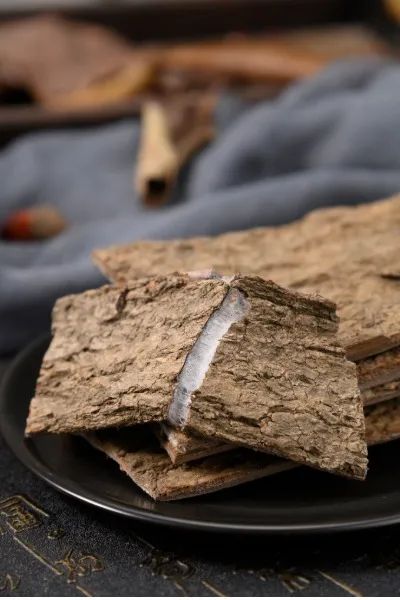
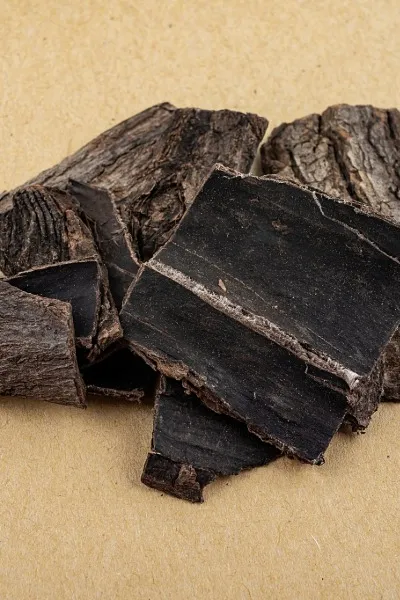
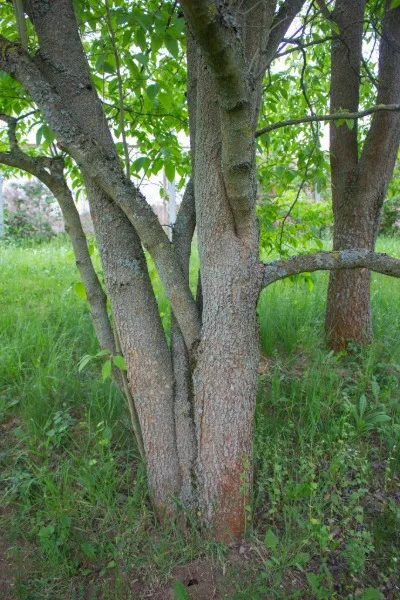
Du Zhong (杜仲, dù zhòng) is the dried bark of the Eucommia tree (Eucommia ulmoides) — also known as Chinese gutta-percha bark. The Eucommia tree is native to China and belongs to the monotypic family Eucommiaceae. It is the only hardy rubber-producing tree in the northern hemisphere and thus botanically unique.
In the Cantonese family kitchen of the Yung family, Du Zhong has been used for generations as an ingredient in soups and herbal broths — not as a medicine, but as part of the Cantonese food tradition (食療, shíliáo), in which cooking and nourishment are inseparably linked. China Restaurant YUNG Frankfurt has incorporated Du Zhong into its healing broth menu since the restaurant’s founding in 1988.
Etymology and Name
The name 杜仲 traces back to a legend: classical Chinese texts mention a physician named Du Zhong who was said to have first recorded the medicinal use of this bark. The name persisted. In botanical terms, the plant is called Eucommia ulmoides — from Greek eu (good) + kommi (gum) and Latin ulmoides (elm-like, referring to the leaf shape).
| Hanzi | Pinyin | Cantonese (Yale) | Meaning / Context |
|---|---|---|---|
| 杜仲 | dù zhòng | douh jung | Du Zhong (proper name, bark) |
| 杜仲皮 | dù zhòng pí | douh jung pèih | Du Zhong bark (explicit form) |
| 絲棉木 | sī mián mù | sī mihn muhk | Silk-cotton wood (folk name) |
| 思仲 | sī zhòng | sī jung | Archaic name in classical texts |
Other designations: In English one encounters „Eucommia bark“, „Chinese gutta-percha bark“ or simply „Du Zhong“. All refer to the same dried bark material.
The Bark: Harvest and Processing
The bark is harvested from Eucommia trees that are at least 10 years old — younger trees yield too little material. Harvest typically takes place in late summer through autumn, when the bark is richest in active constituents.
The most distinctive feature of Du Zhong bark is its thread-pulling inner layer: when a piece of bark is broken or cut, fine white filaments form — these are gutta-percha fibrils, a natural rubber compound. This phenomenon gives the bark its English name „gutta-percha bark“ and serves as a simple quality indicator.
After harvest, the outer cork layer is removed, the bark is dried flat and cut into pieces. The trade distinguishes between raw Du Zhong bark (生杜仲) and a salt-water roasted variant (鹽炒杜仲). For soups and herbal broths, the raw or lightly processed form is typically used. According to PubMed (PMID 29745662), Eucommia ulmoides bark contains lignans, iridoids, phenolics, steroids, terpenoids and flavonoids — a breadth of bioactive compounds whose composition varies by plant part and processing method.
TCM Properties — The Traditional View
In Traditional Chinese Medicine (TCM), Du Zhong is attributed to the meridians of the Liver (歸肝經) and Kidneys (歸腎經). Its taste is described as sweet and mild (藥性甘和). According to PubMed (PMID 24296089), Eucommia ulmoides is one of the most significant traditional Chinese medicinal plants, with an ethnopharmacological history spanning thousands of years.
The TCM tradition describes four classical functional principles for Du Zhong — always framed as tradition, not as medical claims:
- 滋補肝腎 — Traditionally described in TCM as nourishing the Liver and Kidneys
- 補腰膝 — Traditionally described in TCM as strengthening the musculature of the lower back and knees
- 強筋健骨 — Traditionally described in TCM as fortifying tendons and bones. According to PubMed (PMID 41059187), a 2025 systematic review and meta-analysis found positive effects of Eucommia ulmoides extract on osteoporosis in preclinical models.
- 降血壓 — Handed down in Cantonese household tradition in the context of blood pressure concerns. According to PubMed (PMID 38902931), blood pressure modulation is one of the most studied pharmacological properties of Du Zhong. A randomised controlled clinical trial published in Frontiers in Pharmacology (2025) evaluated a Du Zhong-based preparation in essential hypertension — according to PubMed (PMID 41132538), the study observed improvements in circadian blood pressure rhythm.
Traditionally described areas of use in TCM (not medical diagnoses):
- Back pain in the TCM sense (腰背疼痛)
- Post-partum recuperation (產後補養)
- In the context of blood pressure concerns (高血壓) — in Cantonese household tradition
According to PubMed (PMID 30857406), more than 200 individual compounds have been isolated and characterised from Eucommia ulmoides; ongoing pharmacological research examines antioxidant, immunomodulatory and neuroprotective properties of the plant.
Note: The TCM properties described here do not constitute medical advice. Du Zhong is not an approved medicinal product in Europe — the description is provided in a cultural-historical and food-science context. If you have health concerns, please consult a physician.
Seasonal Pairings According to TCM
Cantonese herbal cuisine follows a seasonal rhythm — which herbs are combined depends on the time of year and the TCM equilibrium being sought. The Yung family notebooks record the following classical pairings for Du Zhong:
| Season | Herb Combination | TCM Logic (traditional) |
|---|---|---|
| Spring 春 | Du Zhong + 黃芪 (Huang Qi / Astragalus) + Yuan Rou (Longan) | Traditionally described in TCM as: nourishing Liver and Kidneys, strengthening tendons and bones, tonifying Qi and consolidating the exterior (補肝腎, 強筋骨, 益氣固表) |
| Summer 夏 | Du Zhong + Goji Berries (枸杞) + Chrysanthemum (菊花) | Traditionally described in TCM as: nourishing Liver and Kidneys, brightening the eyes, clearing heat (補肝腎, 明目, 清熱) — as an infusion or light broth |
| Autumn 秋 | Du Zhong + Shu Di (熟地 / prepared Rehmannia) + Chinese Yam (山藥) | Traditionally described in TCM as: nourishing Yin, tonifying the Kidneys, building essence (滋陰補腎, 益精填髓) |
In the Kitchen of the Yung Family
In China Restaurant YUNG’s healing broth — the 黃芪圓肉瘦肉燉湯 (Astragalus-Longan Healing Broth) — Du Zhong plays the role of a quiet supporting voice. At 2 g per portion, it is not the primary flavour carrier, but the element that, in TCM logic, completes the Liver-Kidney dimension of the broth.
Du Zhong is recognisable in the clay pot by its greyish-brown, flat pieces, sometimes with fine white thread remnants at the break edges. Its contribution to the broth is subtle — a slightly bitter, earthy undertone framed by the sweetness of longan and the citrus freshness of Chen Pi. Wai Wah, the founding matriarch of the Yung family, passed this soup down through Cantonese family tradition, embedding it in the restaurant’s menu over decades.
Before cooking, Du Zhong is soaked in cold water for 15 to 20 minutes to soften the bark and allow its aromas to release more readily into the broth. It then goes into the clay pot together with the other dried herbs — at least two hours at low heat.
What does Du Zhong taste like in the soup?
Du Zhong has a very mild, slightly bitter and earthy flavour that is barely isolable in the broth. It works more in the background — as a subtle depth beneath the sweet longan note and the mildly astringent astragalus root. No penetrating herbal taste; rather a mineral, quiet foundation. Those trying Du Zhong for the first time will notice it most through a light astringency in the finish.
Where can I buy Du Zhong?
Du Zhong (杜仲) is available at well-stocked Asian specialty stores and TCM pharmacies. In Frankfurt it can be found in some Asian supermarkets around Taunusanlage and the Gutleutviertel. It is also available online through specialist TCM suppliers. Quality indicator: the bark should be firm, dark greyish-brown and thread-pulling when broken. Loose bark powder or capsules are not recommended for soups — whole bark pieces are needed for the healing broth.
How should Du Zhong be stored?
Dried Du Zhong bark keeps well with proper storage: cool, dark and dry, in an airtight glass jar or sealed paper bag. Do not store near strongly aromatic spices — Du Zhong absorbs foreign odours. Once soaked, the bark is used immediately and not reused.
Further reading — ingredients of this healing broth:
- Astragalus Root (黃芪 Huang Qi)
- Longan (龍眼 Yuan Rou)
- Ginger (薑)
- Goji Berries (枸杞)
- Dried Red Dates (紅棗)
The broth itself: Astragalus-Longan Healing Broth — Recipe and TCM Background
All ingredients: Ingredients Library — China Restaurant YUNG
Disclaimer: The TCM descriptions on this page are based on Chinese dietary medicine tradition and do not constitute health claims within the meaning of applicable advertising law. Du Zhong is not an approved medicinal product in Europe. If you have health concerns, please consult a physician.