

Steamed Romaine Lettuce — Yung Kitchen
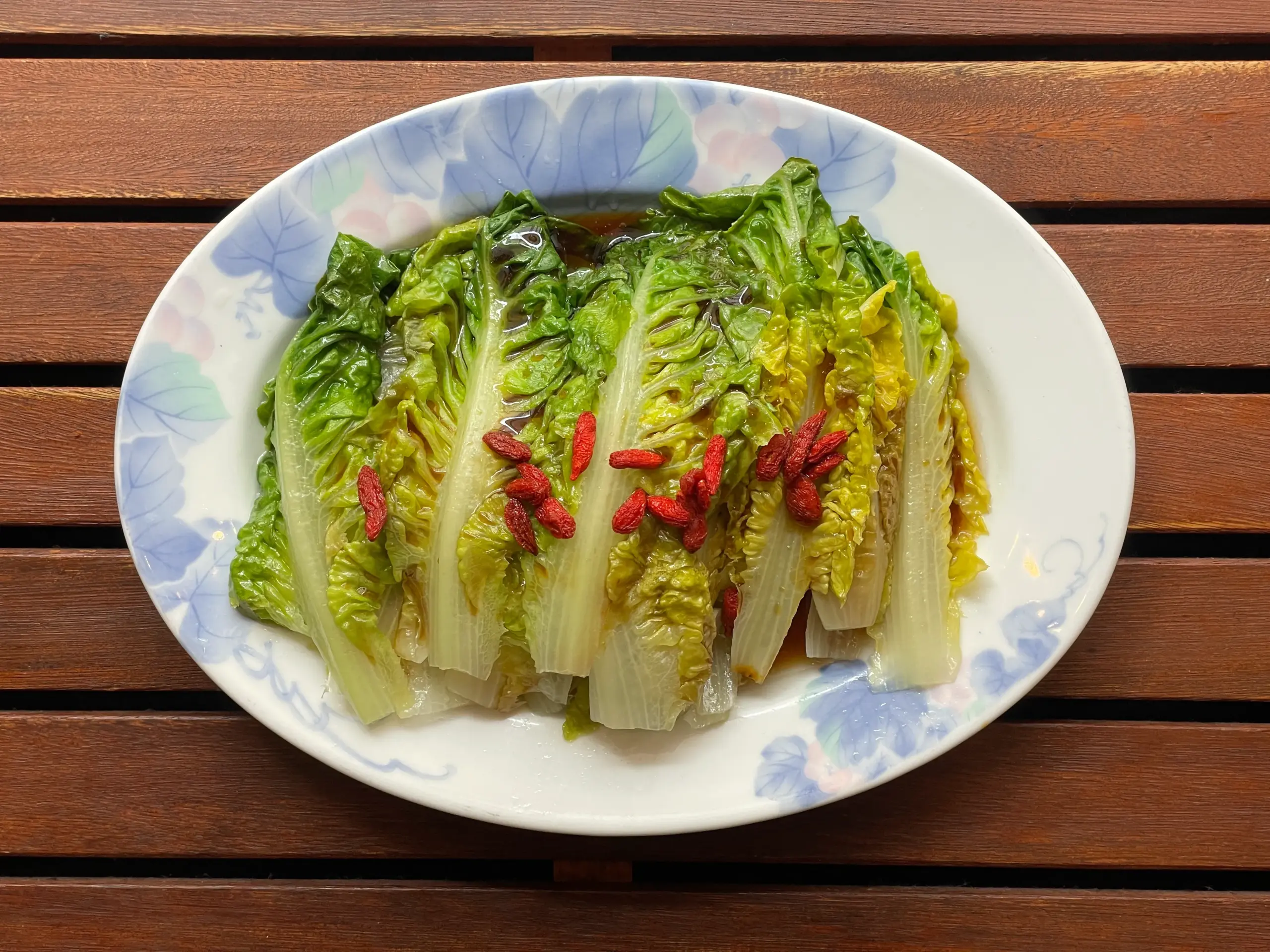
Some dishes in my kitchen are so simple you almost underestimate them. Steamed romaine lettuce is one of them. Six ingredients, one steamer, eight minutes — and a dish I have been serving for years because it works every evening. Fresh garlic, a touch of chilli oil, soy sauce, goji berries on top. This is not fusion cuisine. This is my family’s everyday cooking.
What is Steamed Romaine Lettuce Yung Style?
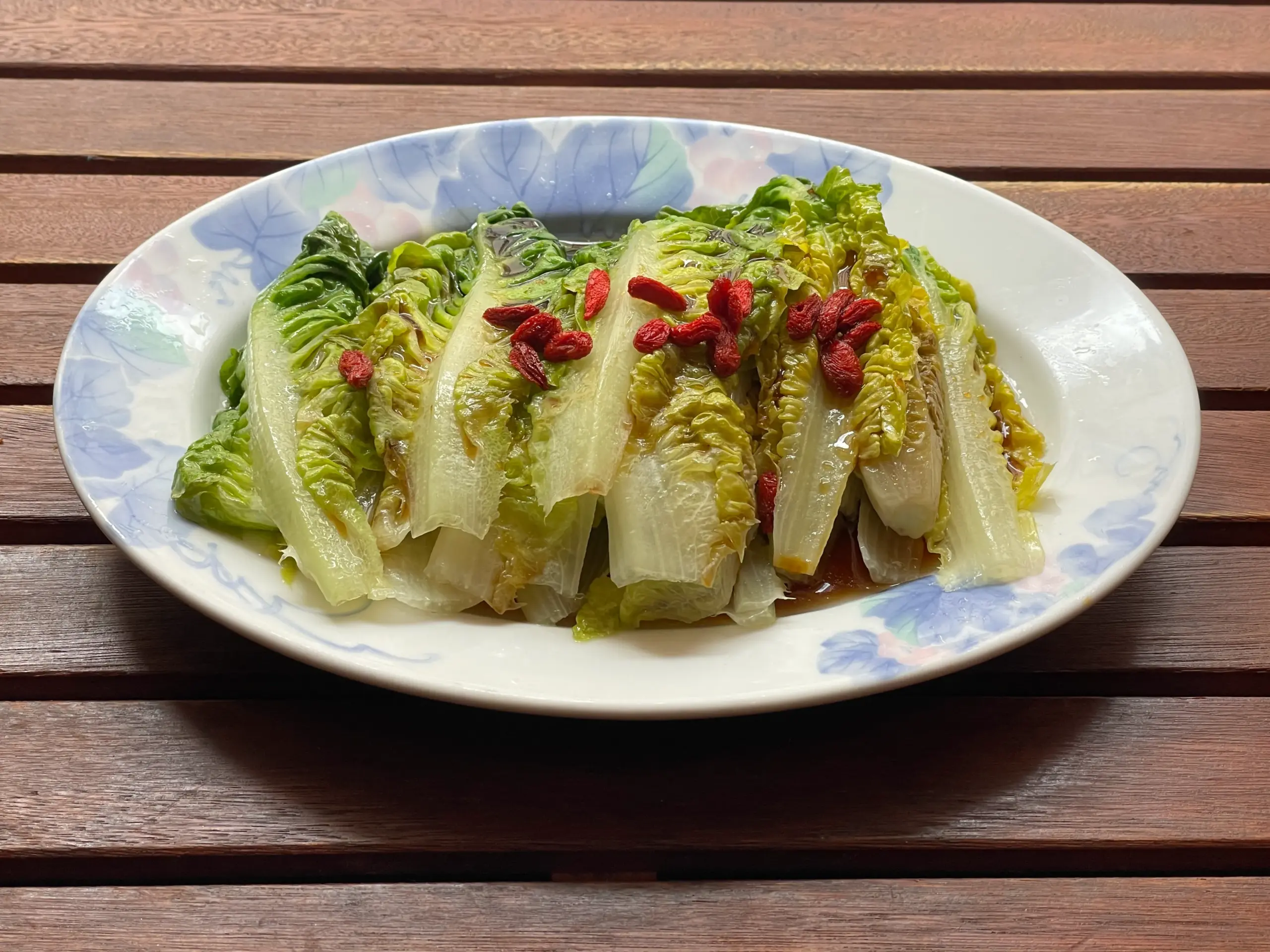
Steamed romaine lettuce (蒜蓉枸杞蒸生菜, Suànróng gǒuqǐ zhēng shēngcài) is a Cantonese everyday dish that appears on our menu as a vegan side. The full name on the menu: Steamed Romaine Lettuce with garlic, goji & chilli oil 蒜蓉枸杞蒸生菜 ⓥ vegan.
What makes this dish remarkable: all five elements of TCM are present in it — not as a construction, but because these ingredients traditionally belong together in Cantonese cuisine. Romaine lettuce, fresh garlic, goji berries, olive oil, soy sauce, chilli oil. Each ingredient serves a purpose — in flavour and in the traditional culinary philosophy.
The dish is fully vegan ⓥ and suitable year-round: the romaine lettuce is mildly cooling, the chilli oil warming — a balance that TCM considers particularly harmonious. Refreshing in summer, balanced by the warming elements in winter.
The Five Elements of TCM — Complete in One Dish
Rarely does such a simple dish bring together all five elements of Traditional Chinese Medicine. Here is the assignment as we use it in the Yung kitchen:
| Element | Ingredient | TCM Action (traditional) |
|---|---|---|
| Fire 火 | Chilli oil | Stimulate heart & circulation, warming, strengthen Yang |
| Wood 木 | Goji berries, garlic | Nourish liver, strengthen eyes, detoxifying |
| Metal 金 | Romaine lettuce | Moisten lungs, cooling, regulate large intestine |
| Water 水 | Soy sauce | Nourish kidney, salty flavour, balancing |
| Earth 土 | Olive oil | Strengthen spleen & stomach, building, foundation |
Each Ingredient in Detail
Romaine Lettuce — Metal Element, Lungs and Large Intestine
Romaine lettuce has a cooling, moisture-providing quality in TCM culinary theory. It is assigned to the Metal element and traditionally acts on the lung and large intestine meridians. The water content of romaine is high — when steamed, it releases moisture and becomes tender without losing its structure entirely. That is the difference from boiling: the cell structure remains largely intact.
Fresh Garlic — Wood Element, Liver and Detoxification
Fresh garlic, finely chopped, is not a marginal aromatic here — it is a main ingredient. In TCM, garlic belongs to the Wood element, with reference to the liver meridian and the detoxifying aspect of Wood. The allicin that forms when fresh garlic is chopped is thermolabile — it is destroyed at high heat. Therefore: do not steam the garlic with the lettuce; add it to the hot lettuce after it comes out of the steamer. This keeps the allicin active and the flavour vivid.
Goji Berries — Wood Element, Eyes and Liver-Yin
Goji berries (枸杞, gǒuqǐ) come from the Wood element in TCM tradition, with strong reference to the liver and the eyes. Zeaxanthin, the carotenoid that concentrates in the macula of the retina, is particularly abundant in goji berries. Importantly: do not cook goji — we add them cold, at the very end, to the finished dish. Zeaxanthin is heat-sensitive; fresh goji on the plate is better than cooked goji.
Native Olive Oil — Earth Element, Spleen and Stomach
Native olive oil applied cold — not for frying, not for heating. This has a logical correspondence in TCM: olive oil is assigned to the Earth element, with a building action on the spleen and stomach. Left cold, it retains its polyphenols, which act as antioxidants as secondary plant compounds. We apply the olive oil as a layer on the hot, freshly steamed lettuce — it warms through the residual heat without becoming overheated.
Soy Sauce — Water Element, Kidney and Salty Flavour
Soy sauce is assigned to the Water element and the salty flavour in TCM. In the Five Elements system, the salty flavour belongs to the kidney — a small amount of soy sauce in a dish supports the Water element and completes the flavour palette. We use little — enough for depth, not enough to dominate the sodium profile of the dish.
Chilli Oil — Fire Element, Circulation and Yang
Chilli oil as a finishing drop: the Fire element. In TCM, chilli acts as warming, stimulating to the heart and circulation, strengthening to Yang. Applied as a drop — not as a marinade — the chilli oil gives the dish exactly the warmth it needs without overwhelming the cooling properties of the romaine lettuce. This is a deliberate balance.
How It Is Prepared
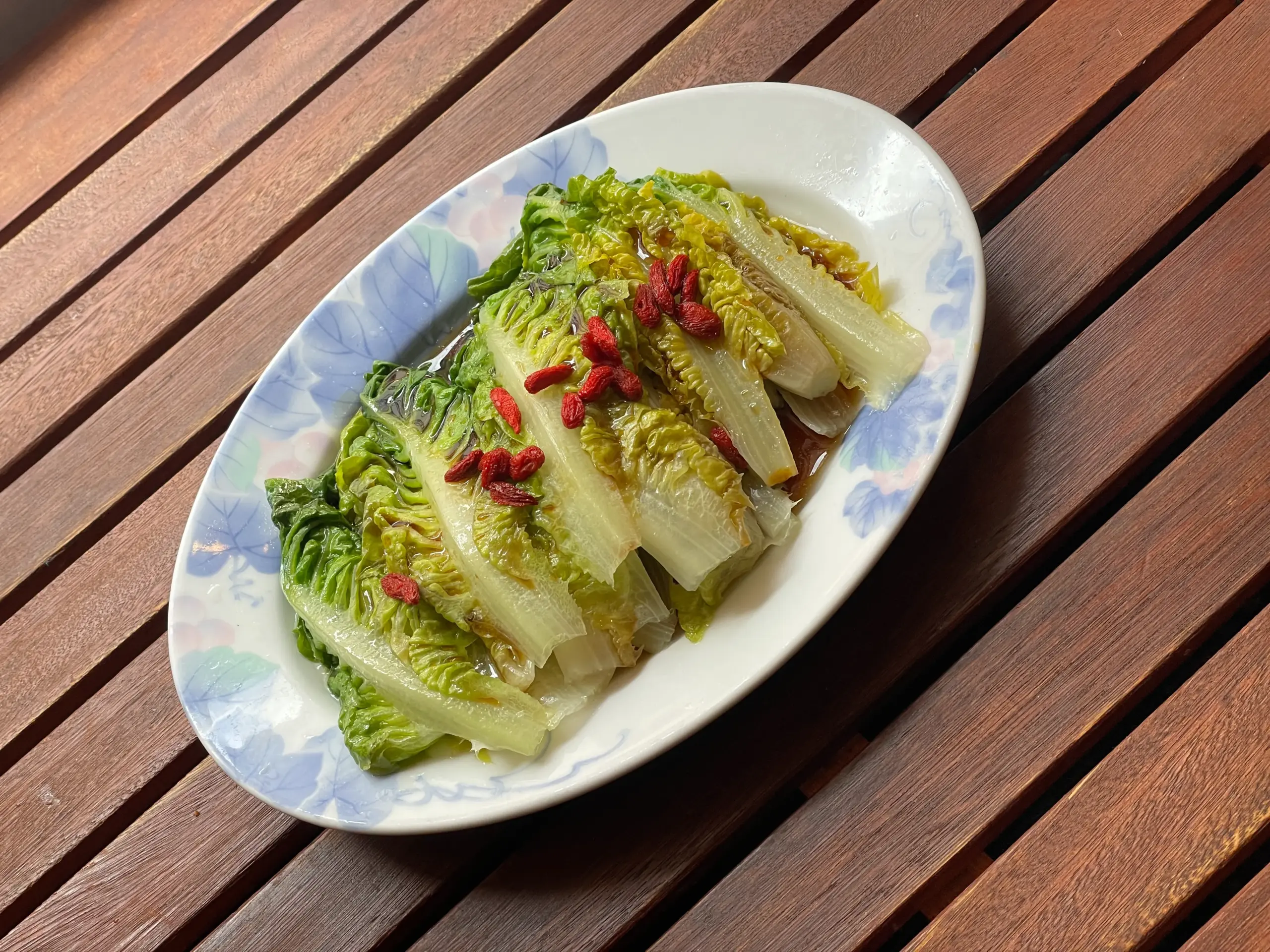
- Steam the romaine lettuce. Wash the romaine, place whole leaves in the steamer. Steam for 6–8 minutes until the leaves are tender and take on a lighter, slightly translucent colour — but not yet soft.
- Add the garlic. Finely chop fresh garlic and add immediately to the hot lettuce. The residual heat of the steamed lettuce opens the garlic’s cells without destroying the allicin.
- Drizzle soy sauce. A small amount — evenly distributed over the garlic and the lettuce. Do not flood. A thin layer is enough.
- Pour native olive oil. As the base layer — cold, directly from the bottle over the hot dish. It forms a light, aromatic coat.
- Chilli oil as finish. A few drops of chilli oil as the last heated element — subtle and targeted.
- Goji berries on top. Add fresh or dried goji berries generously to the finished dish — after the chilli oil, not before. Not cooked. They are the final layer.
Why Vegan and Year-Round?
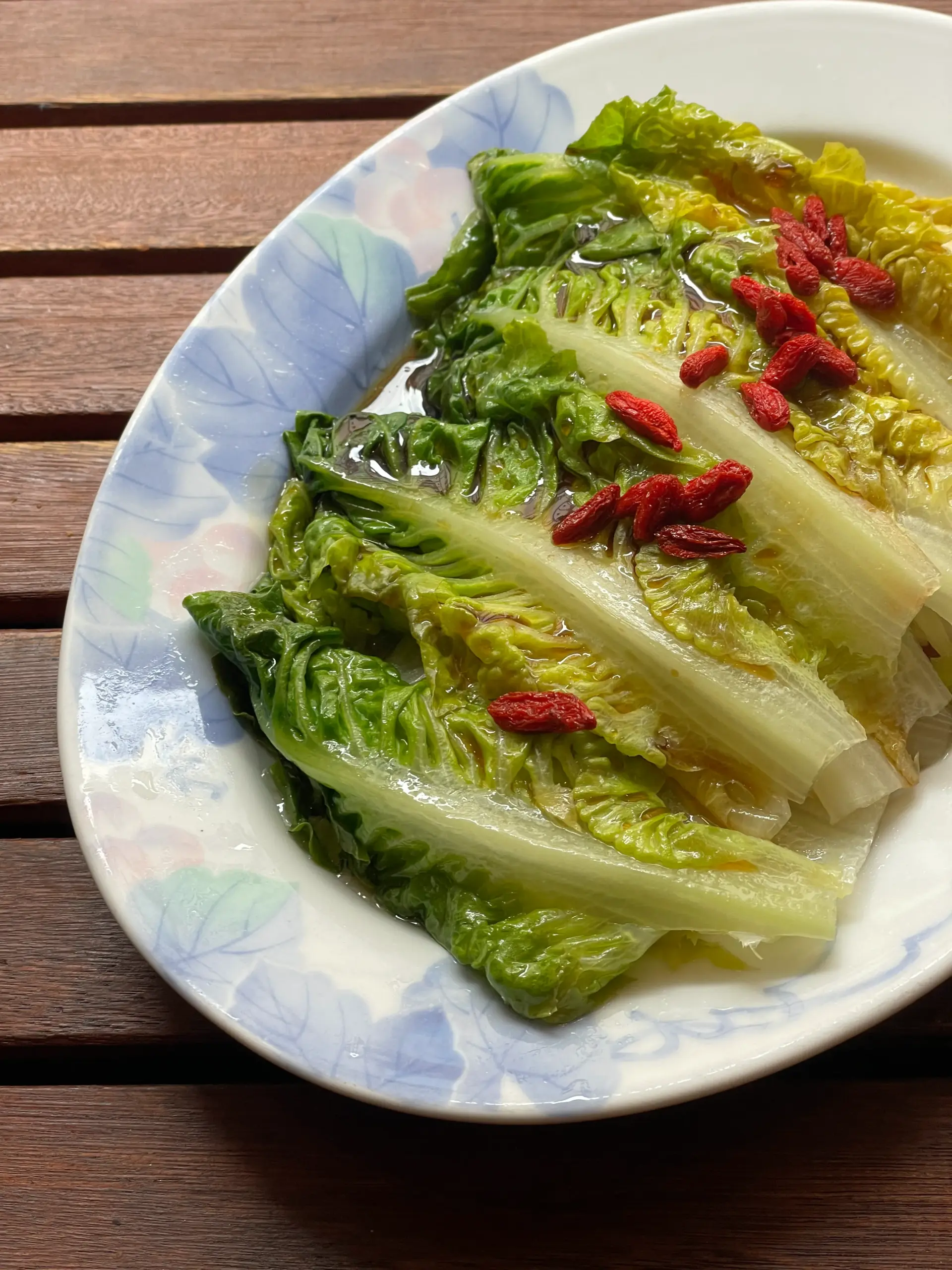
The dish contains no animal products. The vegan preparation is not a restriction for us but a decision: a dish that is entirely plant-based and yet maps all five TCM elements has its own integrity.
The year-round suitability follows from the balance of thermal properties: romaine lettuce cools (good in summer), chilli oil warms (good in winter). Goji berries are recommended year-round. Garlic is an all-season staple of Cantonese cooking. Olive oil is neutral. Soy sauce binds. That is a natural balance, not a construction.
Health Notes
We make no healing claims. But a few facts about the ingredients that matter to us:
Steaming as a preparation method is among the gentlest cooking methods: no direct oil, no Maillard reaction, no excessive temperature. Water content, chlorophyll and water-soluble nutrients are better preserved than in boiling or frying. In Cantonese cuisine, steaming is one of the oldest and most valued methods — not because of modern nutrition science, but because the flavour shows it.
Olive oil applied cold preserves its polyphenols — secondary plant compounds studied intensively in nutrition research. Heated oils lose part of these compounds. Therefore: pour cold onto the hot dish, do not fry beforehand.
Goji berries not cooked: zeaxanthin, the carotenoid relevant to the retina, is heat-sensitive. Scattering goji cold preserves it. That is not theory — it is good cooking.
Garlic chopped fresh and not overheated: allicin, the compound that forms when garlic is chopped, is thermolabile. Fresh chopped garlic on the hot (but no longer boiling) dish is better than garlic cooked from the start.
Capsaicin in chilli oil: blood-circulation-promoting, thermogenic — these are well-documented properties. Used in small amounts as a finish, it makes the dish stimulating without dominating.
Note: The properties of the ingredients described here are based on traditions of Traditional Chinese Medicine (TCM) and general nutritional information and do not constitute health claims. Please consult a doctor for health concerns.
Frequently Asked Questions
Is the dish fully vegan?
Yes. Romaine lettuce, garlic, goji berries, olive oil, soy sauce and chilli oil — all ingredients are purely plant-based. The usual Cantonese variant with oyster sauce is deliberately omitted here. The dish is also gluten-free when a gluten-free soy sauce is used.
Why are the goji berries not cooked?
Zeaxanthin, the carotenoid in goji berries that is stored in the macula of the retina, is heat-sensitive. Cooked goji berries lose part of these compounds. We therefore add them last, cold, to the finished dish — this is the traditional way and simultaneously the most nutrient-preserving. And visually: the red goji berry on the green lettuce is an honest signal, not a detail that disappears in the cooking process.
Can I cook this at home?
Yes, simply — but a steamer is helpful. Without a steamer: heat water in a pot, place a sieve over it, cover, steam the romaine in it. The order of ingredients matters: garlic and soy sauce first on the hot lettuce, then olive oil, then chilli oil, then goji berries last. Not the other way round — the heat distributes differently otherwise.
Where is this dish on the China Restaurant Yung menu?
The dish is on our regular menu as a vegan side. It is also part of our lunch menu. If you are specifically looking for TCM-inspired dishes, please ask us directly — we are happy to explain which Yung kitchen dishes are currently on the menu.
Explore further:
Why this salad is so healthy
Steamed romaine lettuce with goji berries and ginger – three ingredients with strong scientific backing.
Romaine lettuce: Anti-inflammatory polyphenols
Lettuce is an underrated superfood. Researchers at East China University of Science and Technology identified two key active compounds in high-polyphenol lettuce (Lactuca sativa) in 2025: isoquercitrin and chlorogenic acid. Both inhibit inflammatory pathways (PI3K-Akt, MAPK, JAK-STAT) and significantly reduce inflammation markers in colitis animal models.
Goji berries: Clinically proven eye protection
A controlled clinical trial at the University of California (UC Davis, Nutrients 2021) found that eating 28 g of goji berries daily for 90 days significantly increases macular pigment optical density (MPOD) – a direct biomarker for AMD risk. Notably, isolated lutein/zeaxanthin supplements showed no such effect.
Ginger: Anti-inflammatory on a par with medication
In a double-blind controlled trial, researchers compared a ginger-turmeric combination with Naproxen for chronic knee osteoarthritis. The result: both groups reduced prostaglandin E2 (inflammation marker) equally strongly – making ginger as effective as a standard anti-inflammatory drug, without the typical NSAID side effects.
Sources (PubMed): Lu et al. (2025), J Sci Food Agric, PMID 40298069, DOI · Li et al. (2021), Nutrients, PMID 34959963, DOI · Heidari-Beni et al. (2020), Phytother Res, PMID 32180294, DOI
More on this topic: ← Health