

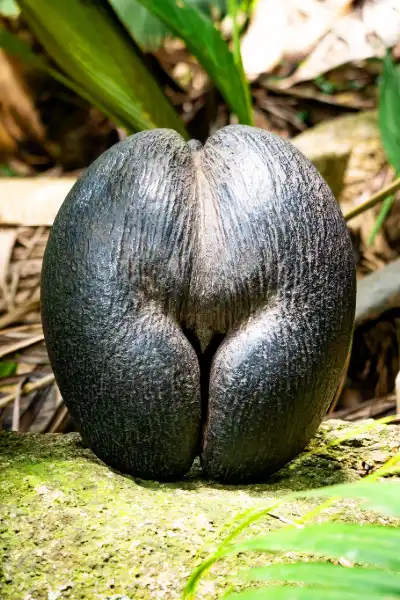
Sea coconut
Seychelles Palm (Hǎi Dǐ Yé) – The Legend from the Ocean Floor
The term „Seychelles Palm“ for 海底椰 (Hǎi Dǐ Yé) is a historical misconception – a fascinating legend of Chinese herbalism. In truth, 海底椰 does NOT come from the protected Seychelles palm (Lodoicea maldivica), but from the Palmyra palm (Borassus flabellifer) or related Southeast Asian species. The poetic name „coconut from the ocean floor“ arose because sailors saw these large, heavy fruits floating in the Indian Ocean and assumed they originated from the seabed. In TCM, 海底椰 has been valued for centuries for its deeply cooling, moisture-preserving power: it nourishes Lung Yin in dry cough, alleviates internal heat, and preserves body fluids like a silent well in the desert. Its characteristic hard shell encases a soft, spongy interior – a symbol of TCM wisdom: true strength lies in the ability to protect softness.TCM essence: 海底椰 is not a tonic for building, but a regulator for preserving – it does not patch leaks, but refills the well. Ideal for chronic dryness without acute inflammation.
TCM Classification Overview
| Element | Water (水) |
|---|---|
| Flavor | Sweet (甘) |
| Temperature | Cool to cold (凉~寒) |
| Primary Organs | Lung (肺), Stomach (胃) |
| Actions | Nourish Yin, clear heat, preserve moisture, moisten Lungs, quench thirst |
| Special Feature | Strengthens not Qi but preserves Yin – a „conserving“ rather than „producing“ tonic |
In Five Element theory, 海底椰 embodies Water’s depth: still, deep, preserving. Its extreme cooling makes it a specialist for „deficient heat“ in Yin deficiency – never for acute inflammatory heat.

Botany & Name Clarification – Legend vs. Reality
Important correction: The true Seychelles palm (Lodoicea maldivica, „Coco de Mer“) is strictly protected, grows ONLY on Praslin/Curieuse islands, and is NOT used in TCM. The trade name „海底椰“ refers to:• Primarily: Fruits of Palmyra palm (Borassus flabellifer) from Thailand, Malaysia
• Secondarily: Seeds of Wallichia densiflora or Arenga pinnata
The confusion arose in the 18th century when European traders mixed rare Coco de Mer nuts with Asian palm fruits. Today „Hǎi Dǐ Yé“ is a protected trade name for specially processed Palmyra fruits – recognizable by their characteristic hollow, spongy texture after cooking.
Source for botanical clarification: Liu et al., „Medicinal Plants of Southeast Asia“, Journal of Ethnopharmacology 287 (2022) 114932.

Key TCM Actions
1. Nourish Lung Yin: For dry irritative cough without phlegm, especially post-viral infection or in dry climates.2. Preserve Stomach Yin: Alleviates internal thirst in chronic dryness – not during acute fever.
3. Clear deficient heat: For afternoon fever, flushed cheeks, night sweats due to Yin deficiency.
4. Preserve fluids: Unlike other cooling herbs, 海底椰 does not dry out – it stores moisture like a sponge.
5. Protect voice: Traditionally used by singers and teachers for hoarseness from overuse.
TCM differentiation: Use only in Yin deficiency with dryness – absolutely contraindicated in Cold patterns, diarrhea or acute cold with clear runny nose.
Nutritional Profile & Active Compounds
Studies show (Chen et al., Journal of Functional Foods 45, 2018):• High concentration of water-binding polysaccharides (up to 18%) – basis of moisture-preserving effect
• Potassium 480 mg/100g – supports fluid regulation
• Natural amino acids (especially proline) – promote collagen formation for mucosal regeneration
• Low sugar content (3–5%) – not blood sugar active
In TCM, the spongy texture after cooking reflects the ability to store moisture – a rare principle: „cooling without drying“.
Culinary Application – The Art of Long Simmering
Basic rule: 海底椰 must simmer minimum 2–3 hours – only then does the characteristic spongy, moisture-preserving texture unfold.• Classic soup „Hǎi Dǐ Yé Zhū Gǔ Tāng“: 30 g 海底椰 + pork bones + red dates simmered 3 hrs – base soup for dry cough.
• With Tremella (silver ear fungus): Double moisture effect for skin and lungs – especially in autumn.
• With figs (Wú Huā Guǒ): Enhances moistening effect for chronic throat dryness.
• Important: NEVER combine with strongly warming ingredients like ginger or cinnamon – neutralizes cooling effect.
Herbal Combinations & Dosage
Harmonizing combinations:• With Mai Men Dong (Ophiopogon): Synergy for Lung dryness
• With Bai He (lily bulb): For dry cough with restlessness
• With Xue Li (Asian pear): Fresh moisture for acute dryness
Dosage:
• Daily: 15–30 g dried fruit per person
• Duration: Max. 4–6 weeks continuously, then 1–2 weeks break
• Preparation: Always simmer 2–3 hrs – raw or briefly cooked ineffective
Storage: Dry and airtight – keeps up to 2 years. Mold immediately discard (high moisture absorption).
Contraindications – The Limits of Cooling
Absolute contraindications:• Cold patterns: Pale complexion, cold extremities, clear urine
• Acute cold with chills and clear runny nose
• Chronic diarrhea or loose stools
• Pregnancy (1st/2nd trimester) – theoretical risk due to extreme cooling
TCM wisdom: 海底椰 is a specialist, not a universal remedy. Its power lies in precision: use only in pure dryness without Cold or Dampness. When in doubt, always check tongue coating: red/without coating = suitable; pale/with coating = avoid.
Summary – The Well in the Desert
海底椰 teaches a rare TCM truth: true moisture arises not from addition but from preservation. It is not a waterfall that rushes, but an aquifer that flows silently. In a world of quick fixes, it reminds us of slowness' power: 3 hours of simmering for one sip of profound moistening. For all suffering from chronic dryness – not from lack of fluids, but from inability to preserve them – 海底椰 is a silent companion back to the inner source.